Frill Pricing Explained: What You Actually Pay in 2026
8 min readUpdated August 20, 2026
On this page▾
- Frill Pricing at a Glance
- Startup Plan — $25/month
- Business Plan — $49/month
- Growth Plan — $149/month
- Enterprise Plan — Starting at $349/month
- The Real Cost of Frill
- Where Frill Is Strong
- Where Frill Gets Expensive
- Frill vs fdback.io Pricing
- When You Should Choose Frill
- When You Should Choose a Frill Alternative
- Final Verdict: Is Frill Worth It?
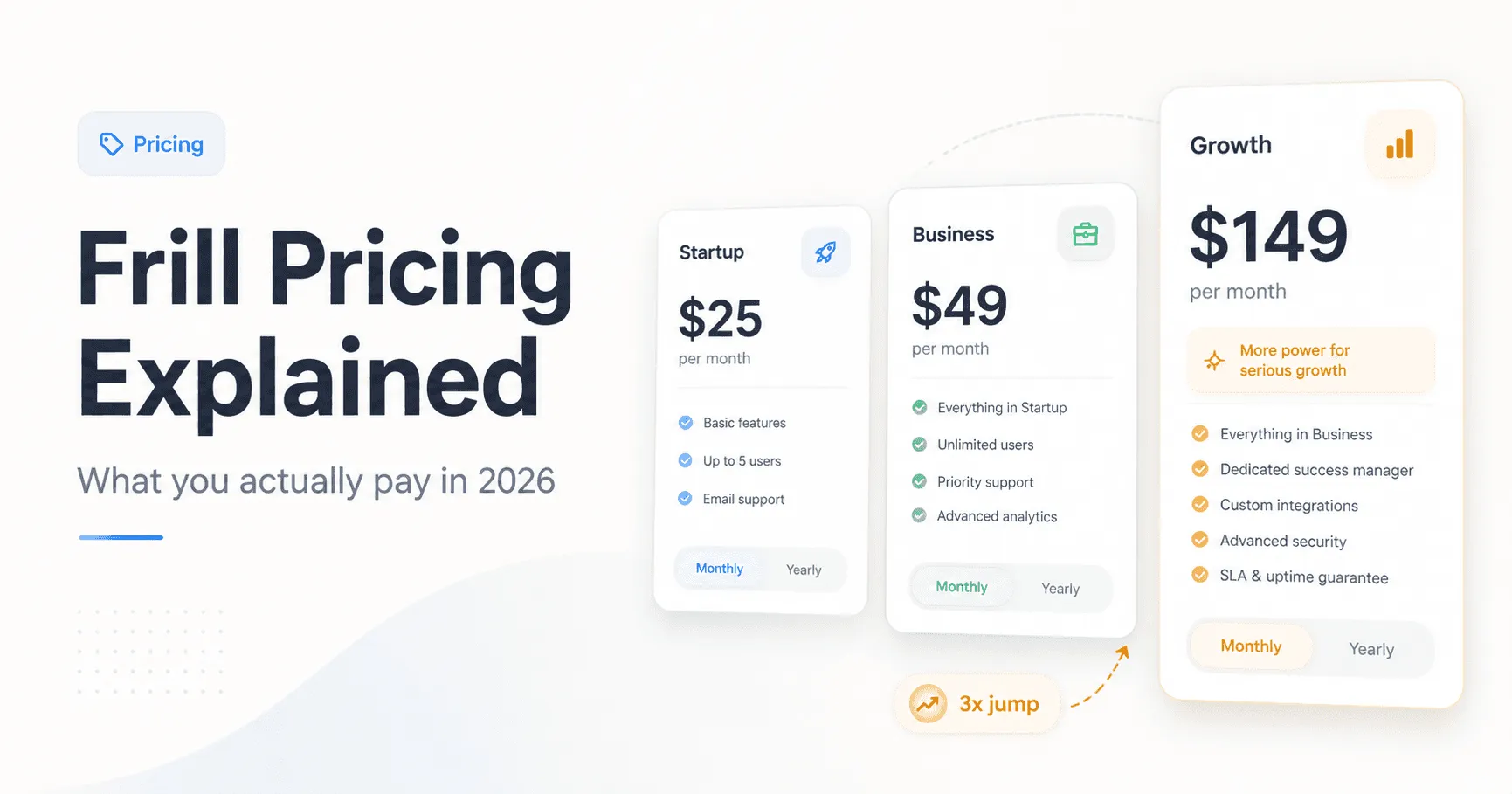
Quick answer: Frill costs $25–$349/month flat (not per seat). Startup is $25/month (50 ideas, 1 survey), Business $49 (unlimited ideas), Growth $149 (privacy, surveys and white-label included), Enterprise from $349. On lower tiers, Privacy (+$25/mo), Surveys (+$25/mo) and White Labeling (+$100/mo) are paid add-ons.
Frill looks simple at first.
You get a clean feedback board, a roadmap, announcements, widgets, and a product that feels much lighter than enterprise tools like UserVoice, Productboard, or Aha!.
And the starting price looks reasonable too: $25/month.
For a small SaaS team, that sounds like an easy yes.
But the real cost depends on what you actually need. If you want unlimited ideas, privacy controls, surveys, or white labeling, the price can move from “cheap feedback tool” to “wait, why is this $149/month?” pretty quickly.
This guide breaks down Frill’s pricing, what each plan includes, where the add-ons matter, and when it makes sense to choose a simpler alternative.
Frill Pricing at a Glance
Frill has four main pricing tiers:
| Plan | Price | Best for |
|---|---|---|
| Startup | $25/month | Small teams testing feedback collection |
| Business | $49/month | Teams that need unlimited ideas |
| Growth | $149/month | Teams that need privacy, surveys, and white labeling included |
| Enterprise | From $349/month | Larger companies with security and compliance needs |
Frill also has add-ons that can change the real price:
| Add-on | Price |
|---|---|
| Privacy | +$25/month |
| Surveys | +$25/month |
| White Labeling | +$100/month |
That means the plan you think you need may not be the price you actually end up paying.
Startup Plan — $25/month
Frill’s Startup plan is the entry-level option.
It includes:
-
50 active ideas
-
1 survey
-
unlimited teammates/managers
-
unlimited tracked users
-
feedback collection
-
roadmap
-
announcements
-
widgets
For a very early-stage product, this can be enough.
If you only want a public board where users can submit ideas and vote, the Startup plan gets the job done. It is clean, simple, and not overloaded with enterprise features.
The main issue is the 50 active ideas limit.
That sounds fine when you are just starting. But once you add old feature requests, bug reports, customer suggestions, internal ideas, and roadmap items, 50 active ideas can become tight.
For many SaaS teams, feedback does not arrive neatly. It piles up.
You may only have 20 customers, but those 20 customers can easily create more than 50 ideas over time.
So the Startup plan is good for testing the workflow, but it may not be the plan you stay on for long.
Business Plan — $49/month
The Business plan is where Frill becomes more usable for growing teams.
The biggest upgrade is simple: unlimited ideas.
That alone makes this plan much more practical than Startup.
If you are serious about collecting feedback, you probably do not want to think about whether a feature request should count toward your limit. You just want to collect everything, organize it, and decide what matters later.
Business also includes 3 surveys instead of 1.
For many SaaS teams, this is probably Frill’s most reasonable plan. It is not cheap-cheap, but it is still affordable compared to tools that charge per seat or based on customer volume.
The catch is that some important features are still add-ons.
Privacy is still +$25/month. Surveys are still +$25/month if you need more. White labeling is still +$100/month.
So the $49/month plan can easily become:
-
$74/month with privacy
-
$74/month with extra surveys
-
$149/month with white labeling
-
$174/month with privacy + white labeling
At that point, the price is no longer just “$49/month”.
Growth Plan — $149/month
The Growth plan includes the things that are add-ons on lower plans:
-
unlimited ideas
-
privacy
-
surveys
-
white labeling
This is the plan you move to when you want Frill to feel more like a fully branded feedback portal.
For example, you may need Growth if:
-
you want to hide Frill branding
-
you want private boards
-
you want more serious survey usage
-
you want a more polished customer-facing experience
-
you do not want to stack multiple add-ons manually
The problem is the jump.
Going from $49/month to $149/month is a big increase, especially for bootstrapped SaaS founders and small teams.
It may be worth it if Frill is central to your product feedback process. But if you only need feedback boards, a roadmap, and changelogs, $149/month can feel like too much.
Enterprise Plan — Starting at $349/month
The Enterprise plan is for larger teams that need things like:
-
dedicated support
-
SOC2 compliance
-
audit logs
-
IP whitelisting
-
dedicated hosting
Most small SaaS teams do not need this.
If you are a solo founder, indie hacker, or small product team, Enterprise is probably not the plan you are evaluating.
It exists for companies with stricter security, procurement, or compliance requirements.
The Real Cost of Frill
Frill’s pricing is not confusing in the same way Canny’s tracked-user pricing can be confusing. You are not paying more just because more users vote or submit feedback.
That is a good thing.
But the real cost depends on which features you consider essential.
Here are a few realistic examples.
Small SaaS with a public feedback board
You want to collect ideas, let users vote, and show a public roadmap.
You can probably start with:
Startup — $25/month
This is fine if you are okay with the 50 active ideas limit.
Growing SaaS with lots of feedback
You are starting to receive more feature requests and do not want to manage limits.
You probably need:
Business — $49/month
This is the plan most small teams will likely grow into.
SaaS with private feedback
You want a private board or more control over who can submit and see ideas.
You may need:
Business + Privacy — $74/month
Now the price is already higher than the advertised Business plan.
SaaS that wants to remove Frill branding
You want a fully branded customer experience.
You may need:
Business + White Labeling — $149/month
At that point, you are effectively paying Growth-level pricing.
SaaS that wants everything included
You want privacy, surveys, and white labeling without separate add-ons.
You need:
Growth — $149/month
This is where Frill becomes more expensive for small teams.
Where Frill Is Strong
Frill is not a bad product.
Actually, it is one of the cleaner feedback tools in the market.
Its strengths are clear:
-
simple UI
-
fast setup
-
public feedback boards
-
roadmap
-
announcements
-
widgets
-
unlimited tracked users
-
unlimited teammates
-
no per-seat pricing on normal team usage
That last point matters.
Some feedback tools become expensive as your team grows. Frill does not punish you for adding more teammates or managers, which is a nice advantage.
It is also much easier to understand than enterprise-heavy tools.
You do not need weeks of onboarding. You can create a board, publish it, and start collecting feedback quickly.
Where Frill Gets Expensive
The main issue is not the base price.
The issue is that the features many teams eventually want are either limited or paid add-ons.
The Startup plan has only 50 active ideas.
Privacy costs extra on Startup and Business.
Surveys cost extra if you need more.
White labeling costs +$100/month unless you are on Growth.
So while Frill technically starts at $25/month, the version many SaaS teams actually want can be closer to $74, $149, or more.
That does not make Frill unfair. It just means you should calculate the real cost before committing.
Frill vs fdback.io Pricing
If you want a simpler feedback setup without stacked add-ons, fdback.io is built for that.
| Feature | Frill | fdback.io |
|---|---|---|
| Free plan | No standard free plan | Yes |
| Paid starting price | $25/month | $15/month |
| Feedback boards | Yes | Yes |
| Public roadmap | Yes | Yes |
| Changelog | Yes | Yes |
| Flat pricing | Depends on add-ons | Yes |
| Good for small SaaS teams | Yes | Yes |
| Built for affordability | Partly | Yes |
Frill is more mature in some areas and has a polished product.
But if your main goal is simple, affordable feedback collection, fdback.io gives you the core feedback loop without making pricing feel heavier as you grow.
You can collect feedback, manage a roadmap, publish changelog updates, and keep users in the loop — without jumping to $149/month just to get a clean customer-facing setup.
When You Should Choose Frill
Choose Frill if:
-
you like its UI and want a polished feedback portal
-
you need announcements and surveys in the same tool
-
you are okay with paying more for add-ons
-
you want unlimited teammates and tracked users
-
you are comfortable moving to $49/month or $149/month as you grow
Frill is a strong option for teams that want something cleaner than enterprise tools, but more established than newer alternatives.
When You Should Choose a Frill Alternative
Choose an alternative if:
-
you want a free plan
-
you want lower monthly costs
-
you do not want to pay extra for every important feature
-
you are a small SaaS team trying to stay lean
-
you mainly need feedback boards, roadmap, and changelog
-
you want a simple tool without enterprise pricing
This is where fdback.io makes more sense.
You get the core system most SaaS teams actually need:
-
collect feature requests
-
let users vote
-
organize feedback
-
show what you are building
-
publish changelog updates
-
close the loop with users
For most small SaaS teams, that is enough.
You do not need a bloated product management suite. You need a simple way to listen to users and show progress.
To see every option side by side, the 7 best Frill alternatives compares them on price, limits, and features.
Final Verdict: Is Frill Worth It?
Frill is worth it if you like the product, need its specific workflow, and are comfortable with the pricing jump as your needs grow.
The $25/month plan is a good starting point, but the 50 active idea limit makes it feel more like an entry plan than a long-term setup for growing SaaS products.
The $49/month Business plan is probably the best value inside Frill.
But once you need privacy, surveys, or white labeling, the real cost can climb quickly.
If you want a simpler and cheaper way to collect feedback, manage a roadmap, and publish changelog updates, fdback.io is a better fit for small SaaS teams.
Start with a free plan, upgrade when you need more, and keep your feedback loop simple.
More insights to explore
The 7 Best Sleekplan Alternatives in 2026 (Honestly Compared)
Sleekplan's free plan is single-admin, and branding removal waits on the $38/mo tier, with metered AI credits and view caps. 7 alternatives compared on price and limits.
Public Product Roadmap: The Complete Guide for SaaS Teams
Learn how to build a public product roadmap that reduces churn, builds trust, and turns users into advocates. Step-by-step guide with examples and tools.
Frill vs Nolt 2026: Full Feedback Loop or Bare-Bones Board?
Frill caps ideas and sells add-ons; Nolt caps boards and skips the changelog. Full pricing tables, feature gaps, and which flat-rate tool fits your team.

How to Collect and Prioritize Feature Requests for a SaaS Product
Complete framework for collecting and prioritizing feature requests. Includes voting boards, scoring models, and tools that close the loop

How to Triage Customer Feedback Without Drowning in It
A practical process for triaging customer feedback: capture, dedupe, categorize, prioritize, respond. Plus cadence, ownership, and when to automate.
Canny vs Nolt 2026: Full Platform or Deliberately Simple?
Canny is a full product-ops platform; Nolt is one deliberately simple board. We compare pricing, features, and the missing changelog to pick a winner.