Canny vs Beamer 2026: Feedback Board or Changelog Tool?
8 min readUpdated August 13, 2026
On this page▾
Canny and Beamer show up in the same searches, sit in the same “product communication” category on review sites, and both end up on the same shortlists. But here’s the thing most comparisons skip: they’re not actually competitors. Canny is a feedback tool that happens to include a changelog. Beamer is a changelog tool that happens to sell a feedback add-on.
That asymmetry changes everything about how you should compare them. The question isn’t “which one is better” — it’s “which direction of communication do you need,” and whether one tool can genuinely cover both.
Full disclosure: we make fdback, a flat-rate tool that covers both the feedback and changelog sides. It appears near the end, but the bulk of this guide is an honest Canny-vs-Beamer breakdown.
Quick Verdict
Pick Canny if: your priority is collecting input — a public board where users submit ideas, vote, and comment, feeding a roadmap. Its built-in changelog is good enough for most teams.
Pick Beamer if: your priority is broadcasting — polished in-app announcements, pop-ups, push notifications, and segmented messaging — and feedback collection already happens somewhere else.
Pick neither alone if: you need the complete loop (collect → vote → plan → ship → notify) on a small budget. Stacking both tools starts around $128/month; simpler all-in-one options cost a fraction of that.
Two Tools Pointing in Opposite Directions
Canny points inward. Users talk to you: they post feature requests on public or private boards, vote on each other’s ideas, and comment. Canny organizes that input, connects it to a public roadmap, and closes the loop with a changelog that notifies voters when their request ships. The changelog exists to serve the feedback workflow.
Beamer points outward. You talk to users: a “What’s New” widget in your app, boosted pop-ups and banners, browser push notifications, email digests, and announcements targeted at specific user segments. Beamer’s job is making sure people actually notice what you shipped. Listening is an afterthought — feedback is a paid add-on with no voting and no public board.
Neither direction is wrong. But they answer different questions. Canny answers “what should we build?” Beamer answers “did anyone notice what we built?”
Pricing Comparison
Both tools meter your audience rather than your team — but they count different things, and that difference matters more than the sticker prices.
Canny counts tracked users: anyone who submits, votes, or comments. Passive visitors are free. Your bill grows with engagement.
Beamer counts MAUs: anyone who loads a page where the widget is installed, whether or not they ever click it. Your bill grows with traffic.
Canny Plans
| Plan | Price (annual) | Tracked users | Notes |
|---|---|---|---|
| Free | $0 | 25 | Effectively a trial — 5 admin seats, no PM integrations |
| Pro | From $79/mo | ~100, then scales | Jira/Linear/GitHub sync, segmentation; a slider raises the price as tracked users grow |
| Business | Custom | 5,000+ | Sales-gated; SSO, CRM integrations |
Exceed your cap without a spending limit set and Canny auto-upgrades your plan. Full scaling math in our Canny pricing guide.
Beamer Plans
| Plan | Price (annual) | MAUs | Notes |
|---|---|---|---|
| Free | $0 | 1,000 | 1 teammate, Beamer watermark |
| Starter | $49/mo | 5,000 | Boosted announcements, custom branding |
| Pro | $99/mo | 15,000 | Reactions, segmentation, inbox, email notifications |
| Scale | $249/mo | 80,000 | Push notifications, priority support |
Feedback and NPS are add-ons on every tier, and Beamer doesn’t publish their prices — user reports range from $30–50/month per add-on to as high as $99/month each. Monthly billing runs about 17% above annual. Full breakdown in our Beamer pricing guide.
Which Meter Bites First?
For most SaaS products, Beamer’s meter fills faster. Every visitor to a widget-equipped page counts as an MAU, so a marketing-driven traffic spike raises your Beamer bill even if changelog readership stays flat. Canny’s tracked-user count only grows when people actively participate — slower, but it means a genuinely successful feedback program gets progressively more expensive. Neither model rewards you for growing; they just penalize different kinds of growth.
Feature Comparison
| Feature | Canny | Beamer |
|---|---|---|
| Feedback board | ✅ | Add-on ($), no public board |
| Voting | ✅ | ❌ |
| Public roadmap | ✅ | ❌ |
| Changelog | ✅ | ✅ (best-in-class widget) |
| Voter notifications on ship | ✅ | ❌ |
| Boosted announcements (pop-ups, banners) | ❌ | ✅ (Starter+) |
| Push notifications | ❌ | ✅ (Scale) |
| Announcement segmentation | ❌ | ✅ (Pro+) |
| NPS surveys | ❌ | Add-on ($) |
| PM integrations (Jira, Linear, GitHub) | ✅ (Pro) | ❌ |
| CRM integrations (Salesforce, HubSpot) | ✅ (Business) | ❌ |
| AI features | ✅ (duplicate detection, Autopilot) | ❌ |
The table makes the split obvious. Canny owns everything upstream of shipping; Beamer owns everything downstream. The only genuine overlap is the changelog itself — and even there, they optimize differently.
Can Canny Replace Beamer?
Partially, and for many teams: yes. Canny’s changelog supports email notifications, an in-app widget, and automatic alerts to everyone who voted on a shipped feature — which is arguably the single highest-value announcement you can send, because it lands with people who explicitly asked for the thing.
What Canny’s changelog can’t do is Beamer’s targeting arsenal: no browser push, no boosted pop-ups or banners, no segment-scoped announcements, no email digests to arbitrary audiences. If your announcement strategy is “publish an update and notify voters,” Canny covers it. If it’s “run targeted in-app campaigns for each release,” it doesn’t.
Can Beamer Replace Canny?
No — and this is the asymmetry that decides most head-to-heads. Beamer’s feedback add-on lets users submit comments through the widget, but there’s no board where requests are visible to other users, no voting, no duplicate merging, and no public roadmap on any plan. You can receive opinions; you can’t aggregate demand. The core mechanic that makes a feedback tool useful — one request accumulating fifty votes so you know it matters — simply doesn’t exist in Beamer.
If you buy Beamer expecting to run a feedback program, you’ll be shopping for a second tool within a quarter.
The Cost of Running Both
Because the tools don’t overlap, plenty of teams end up stacking them — Canny for the board and roadmap, Beamer for announcements. The math gets uncomfortable:
-
Lean stack: Canny Pro ($79/mo at ~100 tracked users) + Beamer Starter ($49/mo) = $128/month, before either meter starts scaling
-
Typical stack: Canny Pro with a few hundred tracked users (the slider climbs well past the $79 base) + Beamer Pro ($99/mo) = several hundred dollars a month
-
And the loop still leaks: your Beamer announcements don’t know who voted in Canny, so the “notify the people who asked” step either runs only through Canny’s own changelog or requires manual coordination between two systems
For funded teams with real announcement-marketing needs, the stack can be worth it. For everyone else, paying two subscriptions to get one workflow is the signal to look at integrated options.
The Honest Verdict
Canny wins for: any team whose bottleneck is understanding what users want. Boards, voting, roadmap, changelog, and PM-tool sync in one product make it the more complete purchase of the two — see our full Canny alternatives roundup for how it stacks up more broadly.
Beamer wins for: teams that already have feedback handled and want the strongest broadcast layer available. The widget, boosted announcements, and segmentation are genuinely best-in-class, and nothing in Canny matches them.
It’s a tie (buy both) for: larger products where announcement targeting drives measurable adoption and the combined bill — $128/month at the entry point, climbing as both meters fill — is a rounding error.
Both are the wrong call for: bootstrapped teams that need collect-vote-ship-notify in one place at a predictable price. Neither tool gives you that alone, and together they’re expensive and disconnected.
A Simpler Alternative to Both
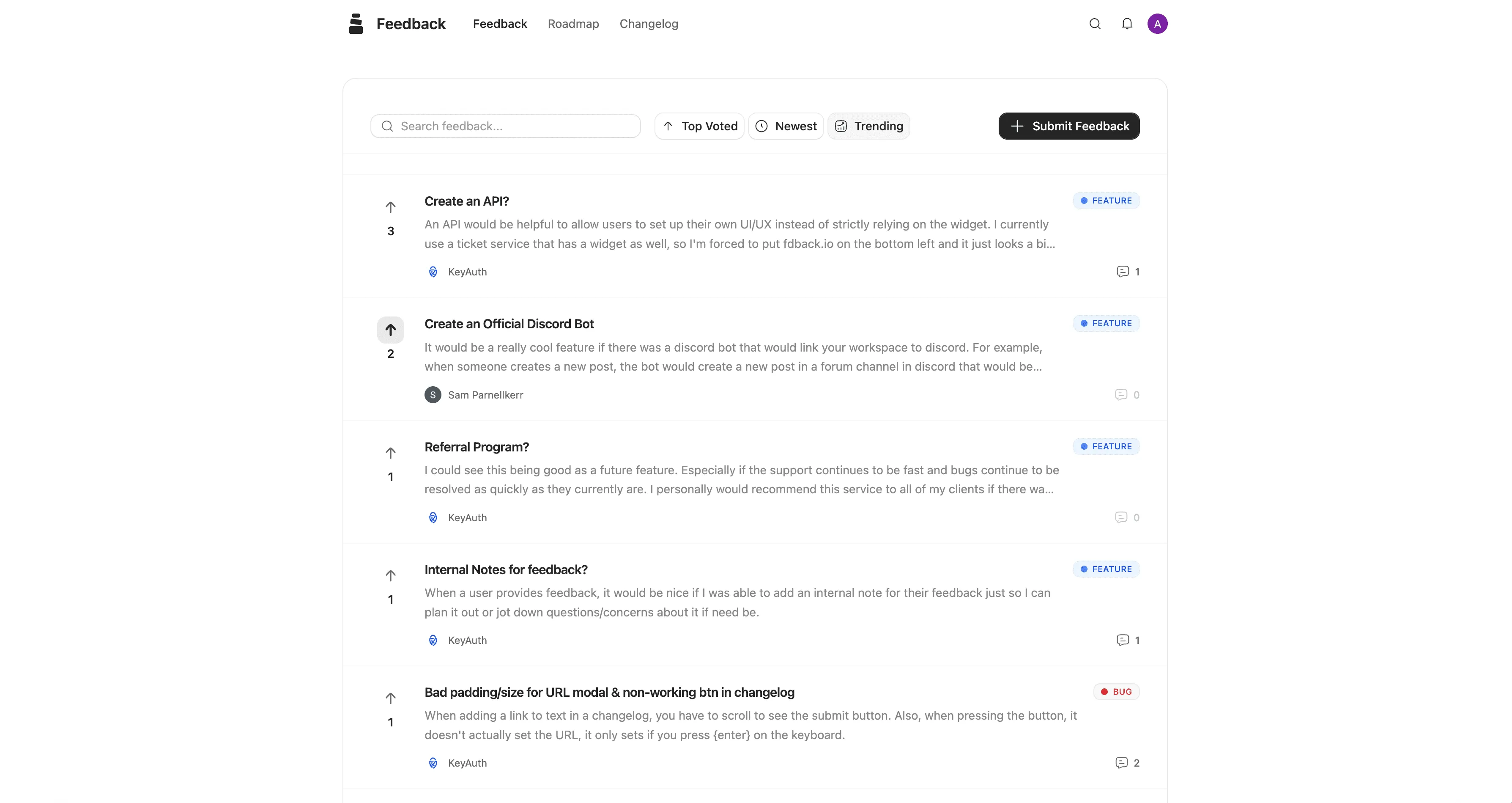
If the stacking math above made you wince, there’s a third path. fdback includes both halves — feedback boards with voting, a public roadmap, and an embeddable changelog — for $15/month flat, with a free plan to start. No MAU counting, no tracked-user meter, no per-seat fees, no add-ons. Publish a changelog entry and every voter on that feature is notified automatically, because both ends of the loop live in the same tool.
What you give up: Beamer’s push notifications, boosted pop-ups, and audience segmentation, plus Canny’s Salesforce integration and revenue-based segmentation (Jira sync is covered on fdback’s Pro plan). If those are dealbreakers, stick with the specialist. If what you actually need is the connected loop, one $15 tool beats two metered ones. Compare directly: fdback vs Canny and fdback vs Beamer.
FAQ
Are Canny and Beamer direct competitors?
Not really. Canny is a feedback-collection platform (boards, voting, roadmap) with a changelog included; Beamer is a changelog and announcement platform with no voting or roadmap on any plan. They overlap only on the changelog, so the comparison is really about which job you’re hiring for.
Does Beamer have a voting board or public roadmap?
No. Feedback on Beamer is a paid add-on that collects submissions through the widget, without a public board or voting. A public roadmap isn’t available on any Beamer plan. Teams that need users to vote on ideas and see what’s planned need a dedicated feedback tool.
Is Canny’s changelog good enough to skip Beamer?
For most teams, yes. Canny’s changelog includes an in-app widget, email notifications, and automatic voter notifications when features ship. You’d miss Beamer’s push notifications, pop-up/banner announcements, and segment targeting — features that matter mainly for larger products running announcement campaigns.
Which is cheaper, Canny or Beamer?
At entry level, Beamer: Starter is $49/month versus Canny Pro from $79/month (Canny retired its cheaper Core tier, so Pro is now its only self-serve paid plan). And the meters differ — Canny’s price climbs with tracked users via a slider, while Beamer scales with MAUs and charges extra for feedback and NPS add-ons. Compare the models in our Canny pricing and Beamer pricing guides.
Do I need both Canny and Beamer?
Only if announcement targeting (push, pop-ups, segmentation) is a core part of your growth motion. Otherwise a single tool that includes feedback, roadmap, and changelog — Canny at its price point, or fdback at $15/month flat — avoids paying two subscriptions for one workflow.
More insights to explore

How to Close the SaaS Feedback Loop (And Why It Reduces Churn)
Turn user requests into a prioritized roadmap. Let your community vote on what’s next, so you can build exactly what they’ll pay for.
Featurebase vs Sleekplan 2026: Which All-In-One Feedback Suite Wins?
Two all-in-one feedback suites, two pricing traps: Featurebase meters AI per resolution, Sleekplan meters seats, credits, and views. Full 2026 comparison.
How to Write Release Notes People Actually Read (With Templates)
Learn how to write release notes users actually read. Includes before/after examples, copy-paste templates, and a simple process your team can repeat.
Upvoty Pricing Explained: What You Actually Pay in 2026
Upvoty costs $15–$49/month flat with no free plan. Full 2026 breakdown of the new Power/Super/Hyper tiers, what each gates, and a $15/mo alternative with a free plan.
How to Say No to a Feature Request Without Losing the Customer
Learn how to say no to a feature request without losing customer trust. Includes the anatomy of a good no and copy-paste templates for every case.

Changelog vs Release Notes: What's the Difference (and Which Do You Need)?
Changelogs and release notes are not the same thing. Clear definitions, a side-by-side comparison, and guidance on when your SaaS needs each one.