Canny vs Featurebase 2026: Which Feedback Tool Should You Pick?
11 min readUpdated August 13, 2026
On this page▾
If you’re comparing Canny and Featurebase, you’ve narrowed it down to two of the most popular feedback tools in the SaaS space. Both cover the core workflow — feedback boards, voting, roadmaps, and changelogs. Both have polished interfaces. Both are used by thousands of SaaS companies.
The differences come down to pricing model, feature depth, and which type of team each one suits best. Canny charges per tracked user and has the deepest integration ecosystem. Featurebase charges per seat and bundles feedback with a full support suite plus AI.
This guide breaks down both tools across pricing, features, scalability, and real-world cost examples — so you can pick the right one for your team without installing both and finding out the hard way.
Full disclosure: we built fdback, a simpler flat-rate alternative to both. We’ll mention it where relevant, but this guide is about choosing between Canny and Featurebase honestly.
Quick Verdict
Pick Canny if: You need deep integrations (Jira, Linear, Intercom, Salesforce), you have a small-to-medium user base, and you want the most mature feedback tool on the market.
Pick Featurebase if: You want feedback + support inbox + help center + AI consolidated into one subscription, and you’re comfortable with per-seat pricing.
Pick neither if: You’re a solo founder or bootstrapped team under $50/month budget. At that point, look at simpler flat-rate alternatives.
Pricing Comparison
The pricing models are fundamentally different, which is the most important thing to understand before comparing anything else.
Canny charges per tracked user — anyone who votes, comments, or submits feedback counts. The more engagement on your board, the more you pay.
Featurebase charges per admin seat — team members who manage feedback. End users are unlimited. But AI resolutions cost $0.49 each on top of the base price.
Side-by-Side Pricing
| Plan Tier | Canny | Featurebase |
|---|---|---|
| Free | 25 tracked users | 1 seat (limited features) |
| Entry paid | Pro — starts at $79/mo (100+ users) | Growth — $29/seat/mo |
| Mid Tier | Pro slider — scales with tracked users | Professional — $59/seat/mo |
| Enterprise | Business — custom (5,000+ users) | Enterprise — $99/seat/mo |
| Billing | Monthly or annual (annual ~20% off) | Annual, or a higher monthly rate |
| AI fees | Included | $0.49 per AI resolution |
For detailed breakdowns, see our Canny pricing guide and Featurebase pricing guide.
Real Cost Examples
Solo founder, 50 tracked users, 1 admin:
-
Canny: Free plan works (under 25 users) or $79/mo Pro
-
Featurebase: Free plan (1 seat) or $29/mo Growth
-
Winner for price: Featurebase Free > Canny Free > Featurebase $29 > Canny $79
3-person team, 500 tracked users, moderate AI use:
-
Canny: Pro’s slider pushes the bill past its $79/mo starting point as tracked users grow
-
Featurebase: $177/mo base (3 × $59 Professional) + ~$245 AI (500 resolutions) = ~$422/mo
-
Winner for price: Likely Canny — especially if AI usage is high
5-person team, 1,000 tracked users, heavy AI use:
-
Canny: Pro, well above the $79/mo base at this engagement level
-
Featurebase: $295/mo base + ~$490 AI (1,000 resolutions) = ~$785/mo
-
Winner for price: Canny in most cases — Featurebase’s AI meter alone can exceed its seat cost
10-person team, 2,000 tracked users:
-
Canny: Pro slider pricing at the higher end of its range
-
Featurebase: $590/mo base + heavy AI costs
-
Winner for price: Canny
The pattern: Featurebase is cheaper at very small scale (free or 1 seat). Canny is cheaper at any real scale, especially if you use AI features in Featurebase.
Feature Comparison
Both tools cover the core workflow, but each has unique strengths.
Feedback Collection
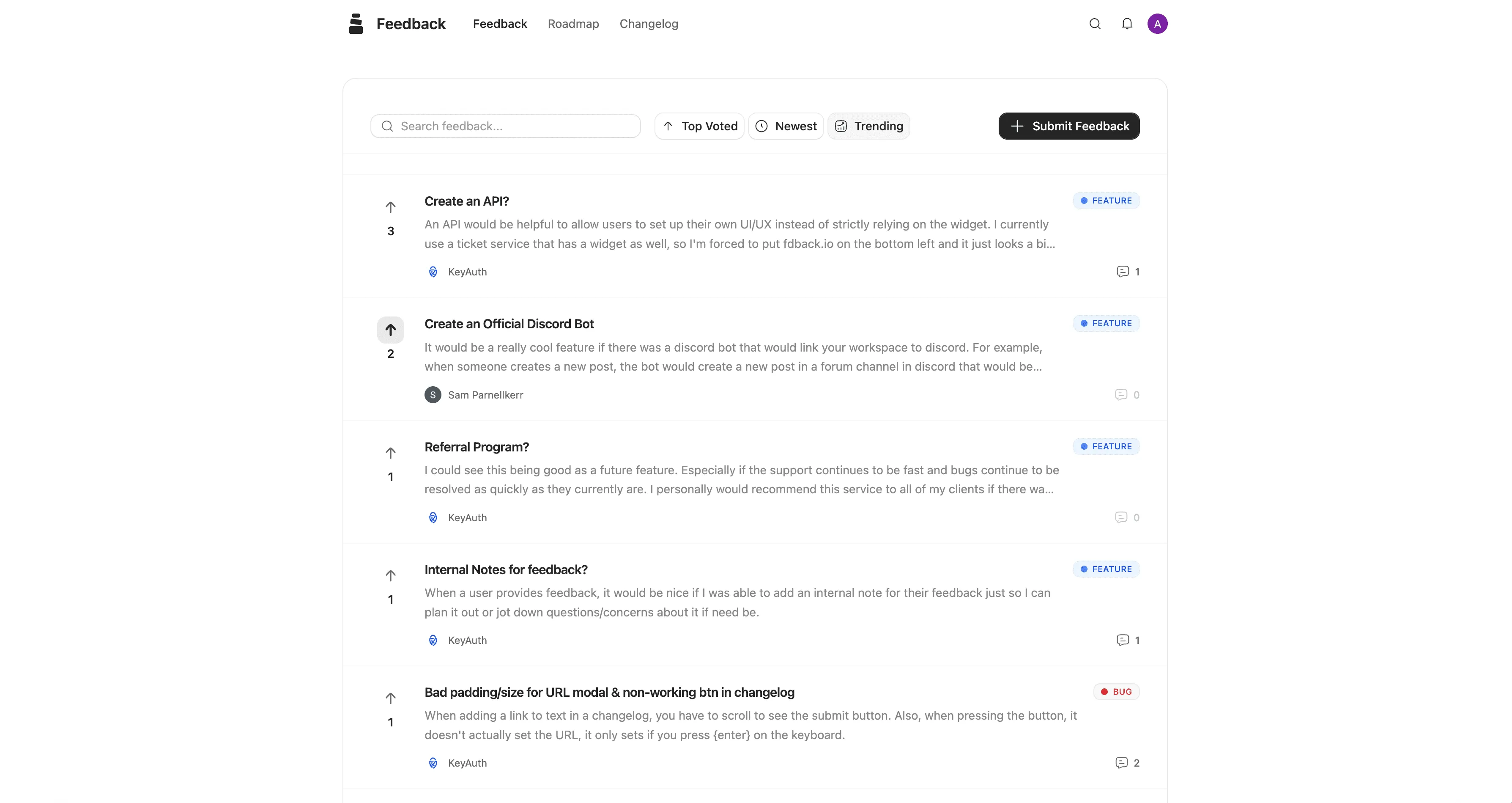
Canny: Native JavaScript widget, public boards, private boards, and an in-app form. Supports capturing feedback from support conversations via Intercom and Zendesk integrations.
Featurebase: Similar widget and board setup. Includes a unified inbox that combines feedback and support tickets — unique among pure feedback tools.
Winner: Tie. Both collect feedback effectively. Featurebase edges slightly ahead if you want feedback and support in one inbox.
Voting & Prioritization
Canny: Standard upvoting, plus internal priority scoring, user segmentation by revenue, and smart duplicate detection.
Featurebase: Upvoting with AI-powered duplicate detection. User segmentation is available on Professional tier ($59/seat).
Winner: Canny, narrowly. The revenue-based segmentation is more mature.
Public Roadmap
Canny: Customizable public roadmap with status columns, ETA estimates, and user notifications when items change status.
Featurebase: Similar roadmap functionality, with tighter integration to the changelog for automatic voter notifications when items ship.
Winner: Tie. Both execute this well.
Changelog
Canny: Built-in changelog with email notifications, in-app widget, and automatic voter notifications.
Featurebase: Same capabilities with a slightly more polished interface. Also supports email digests and Slack integration for changelog entries.
Winner: Featurebase, narrowly.
Integrations
Canny: The deepest integration ecosystem in the feedback space. Jira, Linear, GitHub, Intercom, Zendesk, Salesforce, Slack, HubSpot, PagerDuty, and more. Two-way sync on most of them.
Featurebase: Good integrations (Slack, Intercom, Jira, Linear) but fewer options and less mature two-way sync. Most integrations require Professional plan ($59/seat).
Winner: Canny, clearly.
AI Features
Canny: AI-powered duplicate detection, smart replies, feedback summarization — included on paid plans at no extra cost.
Featurebase: Fibi AI agent that can handle support conversations autonomously, AI copilot, AI replies — but charged at $0.49 per AI resolution on top of seat pricing.
Winner: Depends on usage. Canny’s included AI is better for feedback-focused workflows. Featurebase’s Fibi is more powerful for support automation, but the per-resolution fee gets expensive fast.
Support & Help Center
Canny: Feedback only. If you need a support inbox or help center, you need separate tools.
Featurebase: Full support suite — unified inbox, AI agent, help center with up to 50 articles on free plan, and knowledge base features.
Winner: Featurebase, clearly. If consolidating tools matters, this is the big advantage.
Who Canny Is Built For
Canny is the default choice for mid-size SaaS companies that want a mature, integration-rich feedback tool and have a budget that fits per-user pricing.
Canny works well for:
-
Teams of 5-50 people at funded SaaS companies
-
Products with under 1,000 heavily-engaged users (where tracked-user costs stay reasonable)
-
Organizations that need Salesforce, Jira, or Intercom integration for feedback workflow
-
Product teams that value maturity and stability over cutting-edge features
Canny struggles for:
-
Products with 5,000+ engaged users, where you’re into custom-priced Business territory
-
Solo founders and bootstrapped teams on tight budgets
-
Teams that also need a help center or support inbox (Canny is feedback-only)
-
Products with high engagement-to-revenue ratios (free tools, developer tools)
Who Featurebase Is Built For
Featurebase is the default choice for teams that want to consolidate feedback, support, and AI into one subscription — typically startups with 3-10 people that would otherwise buy multiple tools.
Featurebase works well for:
-
Teams currently paying for feedback + support + help center separately
-
SaaS companies handling significant support volume where AI resolution saves real time
-
Startups that qualify for the 86% startup discount (<2 years old, <6 employees)
-
Teams that prioritize all-in-one consolidation over integration depth
Featurebase struggles for:
-
Larger teams where per-seat pricing multiplies fast ($590/mo for 10 seats alone)
-
Teams that heavily use AI — resolution fees compound quickly
-
Products that only need feedback (you’re paying for a full support suite)
-
Teams locked into specific PM tools where integration depth matters more than consolidation
How Each Tool Scales
This is where the pricing models diverge dramatically.
Canny scales with user engagement. If your product gets more successful and users engage more with your board, your costs increase — even if your team size stays the same. This makes costs somewhat unpredictable: a viral launch could double your Canny bill overnight.
Featurebase scales with team size. If you hire 5 more product managers, your Featurebase bill grows by $145-495/mo depending on the plan. But if your user base explodes, your costs stay flat. This makes costs more predictable for growth-stage teams.
The hidden scaling cost in Featurebase is AI. As your support volume grows and more conversations hit the AI agent, your per-resolution fees grow. At 1,000 resolutions/mo, that’s $490. At 5,000, it’s $2,450. This can quickly exceed the base seat pricing.
Practical advice: Model both tools at your 12-month projected size, not today’s. Canny cheaper for small teams with growing engagement. Featurebase cheaper for stable teams with moderate engagement.
Migration: Canny to Featurebase (or Vice Versa)
If you’re already on one tool and considering switching, migration is easier than you’d expect.
Canny → Featurebase: Featurebase offers a native Canny importer that migrates posts, votes, comments, and users. Most migrations complete in under an hour. Some context may be lost (internal notes, custom fields), but the core feedback data transfers cleanly.
Featurebase → Canny: CSV export from Featurebase, manual import into Canny. Takes 2-4 hours for most teams. Slightly more painful because Canny doesn’t have a native Featurebase importer, but still manageable.
What to do during migration:
-
Export feedback data from your current tool
-
Set up the new tool and test with a small internal team first
-
Import data and verify vote counts transferred correctly
-
Update any integrations (Slack bots, Zapier workflows)
-
Notify users of the change via in-app message or email
-
Redirect your old feedback URL to the new one
The Honest Verdict
Both tools are genuinely good at what they do. The “right” choice depends almost entirely on your stage, budget, and what else you need alongside feedback.
Canny wins if:
-
You need Jira/Linear/Salesforce integration (non-negotiable for many PM-focused teams)
-
Your user base is under 1,000 engaged users and will stay there
-
You only need feedback, not support or help center
-
You prioritize stability and maturity over new features
Featurebase wins if:
-
You’re consolidating multiple tools (currently paying for feedback + support + help center)
-
You qualify for the 86% startup discount
-
You want AI-powered support automation bundled in
-
You value all-in-one over integration depth
Tie scenarios (either works):
-
3-5 person team with moderate user base
-
Standard SaaS workflow without strong preferences
-
Teams that don’t heavily use integrations or AI
Neither is ideal if:
-
You’re a solo founder on a $15-30/month budget
-
You only need the core feedback loop without support or deep integrations
-
You want predictable flat pricing regardless of growth
Simpler Alternatives to Both
If you read the pricing comparison and felt both options were too expensive for your stage, you’re not alone. Most indie founders and bootstrapped SaaS teams find bills running into the hundreds of dollars a month hard to justify for a feedback tool.
fdback covers the core feedback workflow — board, voting, roadmap, changelog, in-app widget, voter notifications — for $15/month flat, with a free plan to start. No per-seat pricing. No tracked-user limits. No AI fees. No add-ons.
What you get: the complete feedback loop in one tool. When you mark a feature as shipped, voters are notified automatically. For solo founders and small teams who just need the essentials without the enterprise price tag, it’s the simplest option.
What you don’t get: CRM integrations (Salesforce), user segmentation by revenue, or a support inbox — Jira and Linear sync are covered on the Pro plan. It’s focused on core feedback, nothing else.
For a broader comparison of all options, see our Best Feedback Tools for SaaS guide, or the Canny alternatives and Featurebase alternatives lists.
FAQ
Which is cheaper: Canny or Featurebase?
It depends on your scale. Featurebase is cheaper for solo founders (free plan or $29/mo for 1 seat). Canny is cheaper for teams of 3+ people with moderate user engagement, especially if you’d use Featurebase’s AI features heavily.
Does Canny have AI features?
Yes. Canny includes AI-powered duplicate detection, smart replies, and feedback summarization on paid plans at no extra cost. Featurebase’s AI is more powerful but charged at $0.49 per resolution.
Can Featurebase replace my help desk tool?
Possibly. Featurebase includes a unified inbox, AI agent, and help center alongside feedback. Whether it fully replaces Zendesk or Intercom depends on your support volume and complexity.
Which has better integrations?
Canny, clearly. Canny has deeper, more mature two-way integrations with Jira, Linear, Intercom, Salesforce, Zendesk, and more. Featurebase has good integrations but fewer options and requires higher plans to unlock most.
Do both have free plans?
Yes, but they work differently. Canny’s free plan caps at 25 tracked users (most products outgrow this quickly). Featurebase’s free plan gives you 1 seat with limited features and unlimited end users.
Which one has a public roadmap?
Both. Canny and Featurebase both include public roadmaps on all paid plans, with status columns and user notifications.
What’s the best alternative if both are too expensive?
For solo founders and bootstrapped teams, fdback ($15/mo flat, with a free plan) covers the core workflow — feedback, voting, roadmap, changelog, widget, voter notifications — without per-user or per-seat scaling. For a complete comparison, see our Best Feedback Tools for SaaS guide.
Can I migrate from Canny to Featurebase easily?
Yes. Featurebase has a native Canny importer that migrates posts, votes, comments, and users. Most migrations complete in under an hour. Moving in the other direction (Featurebase → Canny) requires manual CSV import.
Still Deciding?
Canny and Featurebase are both solid tools for the right team. But if you’re a solo founder or small SaaS team looking at hundreds of dollars a month and wondering if that’s really necessary — it’s probably not.
fdback gives you the complete feedback loop for $15/month flat. Board, voting, roadmap, changelog, widget, notifications. No per-seat or per-user scaling. No AI fees.
More insights to explore
Featurebase vs Frill 2026: Which Modern Feedback Board Wins?
Featurebase charges per seat plus AI fees; Frill is flat-rate with add-ons and idea caps. Full pricing math, feature tables, and the winner by team size.
The 8 Best Pendo Alternatives in 2026 (Honestly Compared)
Pendo averages $47,000/year for an analytics platform where feedback is an afterthought. We compare 8 alternatives for feedback, roadmaps, and changelogs.
Featurebase vs Nolt 2026: All-In-One Suite or Minimal Board?
Featurebase bundles feedback, support, and AI at $29–99 per seat. Nolt is a flat $29–69/mo board with roadmap and changelog. Honest 2026 comparison with real costs.

How to Collect and Prioritize Feature Requests for a SaaS Product
Complete framework for collecting and prioritizing feature requests. Includes voting boards, scoring models, and tools that close the loop

How to Triage Customer Feedback Without Drowning in It
A practical process for triaging customer feedback: capture, dedupe, categorize, prioritize, respond. Plus cadence, ownership, and when to automate.
Frill vs Nolt 2026: Idea Caps or Board Caps?
Frill caps ideas and sells add-ons; Nolt caps boards and has no free plan. Both now ship changelogs. Pricing tables, feature gaps, and which one fits.