Canny vs Productboard vs Featurebase 2026: Three Tools, Two Different Jobs
7 min readUpdated August 20, 2026
On this page▾
Quick answer: Canny and Featurebase are customer-facing feedback boards; Productboard is an internal product-management platform — a different job. Canny bills per tracked user (Pro from $79/month), Featurebase per seat (Growth $29/seat/month), Productboard per maker (Plus $19/maker/month), all billed annually. Pick Canny for the most mature feedback loop with a modest user base, Featurebase for feedback plus helpdesk in one per-seat bundle, and Productboard when you’re buying prioritization for the product org, not the customers.
If your shortlist reads “Canny vs Productboard vs Featurebase,” you’re actually comparing across two different categories without realizing it. Canny and Featurebase are customer-facing feedback tools: public boards, voting, roadmaps your users can see. Productboard is an internal product-management platform: insight repositories, prioritization frameworks, and portfolio views your customers never touch.
That distinction decides more than any feature table. Pick Productboard when you needed a feedback board and you’ll pay platform prices for a portal your users barely interact with. Pick a voting board when your product org needed a prioritization system and your PMs will end up running strategy in spreadsheets anyway.
This guide breaks down all three across pricing models, features, and team fit — using each vendor’s official pricing as of August 2026.
Full disclosure: we built fdback, a simpler flat-rate feedback tool. We’ll mention it at the end, but the three-way analysis stands on its own.
Quick Verdict
Pick Canny if: you want the most mature customer-facing feedback loop and your engaged user base is modest. Its per-tracked-user pricing is friendly early and expensive at scale.
Pick Featurebase if: you want feedback, changelog, and a support helpdesk consolidated into one per-seat subscription, and your team is small enough that seats stay cheap.
Pick Productboard if: you’re buying for the product org, not the customers — formal prioritization, insight clustering from sales/support calls, roadmap views for executives. It’s a different job.
Pick none of them if: you’re a bootstrapped team that mostly needs boards, votes, roadmap, and changelog at a predictable price. That’s the gap flat-rate tools exist to fill.
Three Tools, Three Pricing Meters
The most important thing to understand: each tool meters a different population.
- Canny bills by tracked users — anyone who votes, comments, or posts feedback. Your audience is the meter.
- Featurebase bills by seats — team members who manage feedback. Your team is the meter, end users are unlimited.
- Productboard bills by makers — PMs and leads who own roadmaps and insights. Your product org is the meter.
The same company can get radically different bills from each model. A two-founder startup with 3,000 engaged users pays the most on Canny and the least on Featurebase. A 20-person product org with a quiet feedback portal pays the most on Productboard.
Official Pricing (August 2026)
| Canny | Featurebase | Productboard | |
|---|---|---|---|
| Free plan | 25 tracked users, 5 managers | 1 seat, no AI | 1 portal, 500 feedback items, 50 AI credits/mo |
| First paid tier | Pro — starts at $79/mo (billed yearly), price scales with tracked users | Growth — $29/seat/mo (annual) or $37 monthly | Plus — $19/maker/mo (annual) or $25 monthly |
| Mid tier | — | Professional — $59/seat/mo (annual), includes 20 Lite seats | Business — $59/maker/mo (annual), 2-maker minimum, 14-day trial |
| Top tier | Business — custom, 5,000+ tracked users, SSO | Enterprise — $99/seat/mo (annual), SSO, multi-brand | Enterprise — custom, 5-maker minimum, SSO |
| Remove branding | Paid plans | $69/mo add-on, Professional plan and up | n/a (internal tool) |
A few fine-print items worth knowing:
- Canny’s overage behavior: if you don’t set a spend limit, exceeding your tracked-user allowance automatically upgrades you to the next pricing step, pro-rata. Growth in board activity converts directly into invoice growth unless you cap it (which pauses tracking instead).
- Featurebase’s white-label cost: removing “Powered by Featurebase” is a $69/month add-on on top of your seats, and it’s only available from the Professional plan up. A 2-seat team that wants a clean board is realistically at $59 × 2 + $69 ≈ $187/month.
- Productboard’s contributor cap: free “contributor” roles are capped at 25 on every plan below Enterprise — the “whole company collaborates” pitch has a hard ceiling until you’re on a custom contract.
What Each Tool Actually Does
Canny: the customer feedback incumbent
Canny’s center of gravity is outside your company. Users land on a public board, search for their idea, vote, and watch the roadmap. Your team triages and responds. It’s the most battle-tested tool in the category, with deep PM integrations (Jira, Linear) on Pro and CRM integrations (Salesforce) reserved for the sales-gated Business tier.
The trade-off is the meter. A successful board — the thing you bought Canny to create — is precisely what raises the bill. Teams with vocal communities routinely find engagement growth outpacing revenue growth.
Featurebase: the all-in-one challenger
Featurebase has evolved from a feedback board into a support suite: feedback, changelog, roadmap, and a helpdesk with AI agents, all in one per-seat subscription. Unlimited end users, unlimited feedback items on every plan. If you’d otherwise pay for a feedback tool and an Intercom-style inbox, the bundle math can genuinely work.
The trade-offs: per-seat pricing punishes wider teams, the AI agent bills per resolution ($0.49 each) on top of seats, and de-branding your board costs more than most competitors’ entire plans.
Productboard: the internal PM platform
Productboard’s daily users are your makers — PMs clustering insight notes, scoring features against objectives, building executive roadmap views. Customers see at most a lightweight portal (one on Free/Plus, two on Business). There’s no public voting community and no changelog; that’s not what it’s for.
It’s the only tool of the three that supports formal quarterly planning across product lines. It’s also the only one where a 10-person product team is a five-figure annual commitment before anyone outside the org sees anything.
Feature Comparison
| Canny | Featurebase | Productboard | |
|---|---|---|---|
| Public voting board | ✅ | ✅ | ❌ (portal only) |
| Public roadmap | ✅ | ✅ | Limited (portal) |
| Changelog | ✅ | ✅ | ❌ |
| Support helpdesk | ❌ | ✅ | ❌ |
| Insight repository / clustering | Basic | Basic | ✅ Deep |
| Objectives / OKR alignment | ❌ | ❌ | ✅ |
| Jira / dev integrations | ✅ Pro | ✅ | ✅ (1 connection below Business) |
| Salesforce | Business only | Enterprise | Enterprise only |
| SSO | Business | Enterprise | Enterprise |
| Setup time | Hours | Hours | Weeks |
Which One Fits Your Team
Solo founder or small startup collecting first feedback: Featurebase’s free plan (1 seat, unlimited feedback) or Canny’s free plan (25 tracked users) both work as trials. Canny’s free cap is easy to blow through the moment a board gets any traction; Featurebase’s single seat is fine until a second person needs to triage.
Growing SaaS with an engaged community: this is where the models diverge hardest. On Canny, thousands of engaged voters push the slider well past the $79 starting point. On Featurebase, the same community is free — you pay for your team, plus $69/month if you want your own branding. Featurebase generally wins this profile on price; Canny wins on integration depth and maturity.
Product org with formal planning rituals: Productboard, and it’s not close — the other two simply don’t do insight clustering, objective scoring, or portfolio views. Budget $59/maker/month (annual) on Business, and note that Salesforce and SSO force the custom-priced Enterprise tier. If you also want a public feedback community, teams commonly pair Productboard with a lightweight board — which doubles the tooling but keeps each tool doing its actual job. More on that pairing in our Productboard alternative guide.
Bootstrapped team that wants the core loop, period: boards, votes, roadmap, changelog, widget — and a bill that doesn’t move when your community grows or you add a teammate. None of the three is really built for you.
The Flat-Rate Footnote
That last profile is why we built fdback: the customer-facing feedback loop — boards, voting, public roadmap, changelog, in-app widget — at a flat price, with unlimited end users and no per-seat meter. It deliberately doesn’t do Productboard’s job (no OKR frameworks, no portfolio views), and it skips the helpdesk suite. If your evaluation keeps circling back to “we just need the feedback part,” the comparison with Canny and with Featurebase cover the head-to-heads.
Related Comparisons
- Canny vs Featurebase — the two customer-facing tools head to head
- Canny vs Productboard — feedback loop or PM platform
- Canny pricing breakdown
- Featurebase pricing breakdown
- Featurebase alternatives — 8 options compared
- Canny alternatives — 9 options compared
- Best feedback tools for SaaS
Pricing verified against canny.io/pricing, featurebase.app/pricing, and productboard.com/pricing in August 2026. Vendors change pricing — check their pages before deciding.
More insights to explore
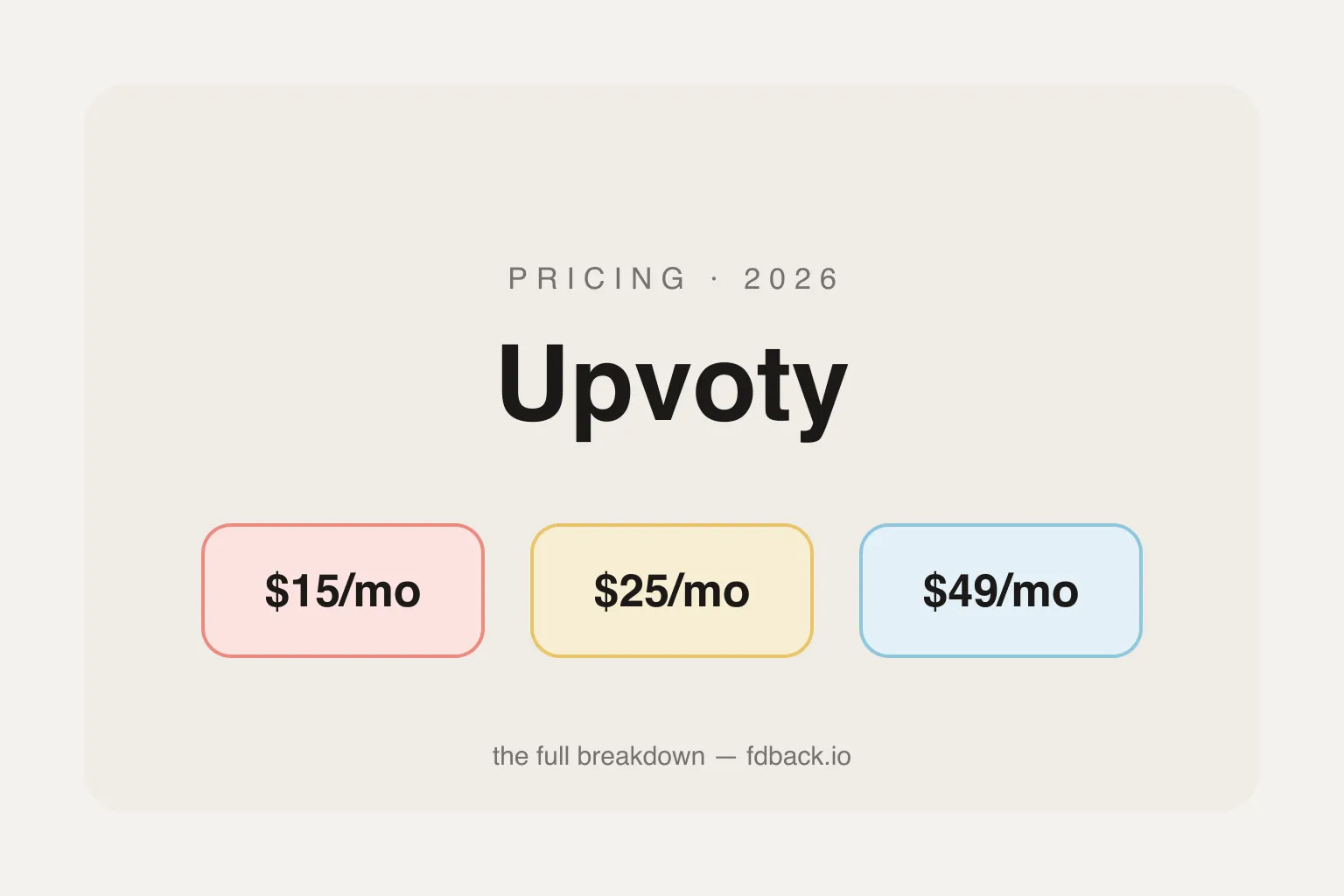
Upvoty Pricing Explained: What You Actually Pay in 2026
Upvoty costs $15–$49/month flat with no free plan. Full 2026 breakdown of the new Power/Super/Hyper tiers, what each gates, and a $15/mo alternative with a free plan.
Featurebase vs Beamer 2026: Feedback Platform or Changelog Tool?
Featurebase is a feedback platform with a changelog. Beamer is a changelog tool without feedback boards. Which to pick in 2026 — and when you need neither.
Canny vs Beamer 2026: Feedback Board or Changelog Tool?
Canny collects feedback with voting boards; Beamer broadcasts changelogs by MAU. Pricing tables, feature gaps, and when you actually need both tools.
The 7 Best Frill Alternatives in 2026 (Honestly Compared)
Frill's $25/mo plan caps you at 50 ideas, and add-ons push the real cost to $150+. We compare 7 Frill alternatives on pricing, features, and limits.

Featurebase Pricing Explained: What You Actually Pay in 2026
Featurebase runs $29–$99 per seat monthly, plus $0.49 per AI resolution and $69/mo to remove branding. Real totals by team size — and a $15 flat alternative.
The 7 Best Aha! Alternatives in 2026 (Honestly Compared)
Aha! costs $39–59/user/month and takes weeks to configure. We compare 7 lighter alternatives for feedback boards, roadmaps, and changelogs.