Canny vs Pendo 2026: Which One Should You Actually Buy?
7 min readUpdated August 13, 2026
On this page▾
Teams end up comparing Canny and Pendo because both show up when you search for “user feedback software.” But they arrived at feedback from opposite directions. Canny built a feedback tool and kept building feedback features. Pendo built a product analytics platform — session replays, product tours, adoption tracking — and attached a feedback module to it, one that users consistently rank among its weakest features.
That origin story matters more than any feature checklist, because it determines what you’re paying for. With Canny, every dollar goes toward the feedback loop. With Pendo, feedback rides along on an enterprise analytics contract that averages $47,000 a year.
This comparison covers what each tool actually does well, what they really cost, and — importantly — when the right answer is neither one alone but a combination.
Full disclosure: we make fdback, a flat-rate feedback tool. It appears once near the end; the rest of this is a straight Canny-vs-Pendo assessment.
Quick Verdict
Pick Canny if: feedback is the job. You want a public board, voting, a roadmap, a changelog, and integrations into Jira or Linear — at self-serve prices you can see before talking to anyone.
Pick Pendo if: behavioral analytics is the job. Session replays, in-app guides, and feature-adoption tracking are genuinely Pendo’s strengths, and the feedback module comes along as a bonus you didn’t buy it for.
Pick a combination if: you need both. A dedicated analytics tool plus a dedicated feedback tool typically undercuts a single Pendo contract — more on that below.
Start With the Problem, Not the Product
Before any table, answer one question: what will your team open this tool to do every week?
If the answer sounds like “see which requests have the most votes, update the roadmap, announce what shipped” — that’s a feedback workflow, and buying Pendo for it means paying analytics-platform prices for its least-loved module. If the answer sounds like “watch how users move through onboarding, replay sessions where they got stuck, measure adoption of the new editor” — that’s analytics, and no feedback tool on the market will do it, Canny included.
Most teams comparing these two are actually feedback buyers who found Pendo on a list. Be sure that’s not you before reading a sales deck.
Pricing: Published vs “Contact Sales”
The pricing experience alone separates these products into different leagues.
| Canny | Pendo | |
|---|---|---|
| Published pricing | Yes — $0, from $79/mo, custom | No — contact sales for everything |
| Typical annual cost | ~$948+, scaling with tracked users | ~$47,000 average |
| Minimum realistic spend | Free plan (25 tracked users) | ~$7,000/year contract minimum |
| Pricing meter | Tracked users (customers who post, vote, comment) | Monthly active users × feature tier, plus add-ons |
| Free tier | 25 tracked users | 500 MAUs, Pendo branding on roadmaps and surveys |
| Time to first feedback | Same day | Weeks of implementation |
Two meters worth understanding:
Canny meters engagement. Only customers who actually submit, vote, or comment count as tracked users. Paid pricing starts with Pro at $79/month (billed yearly) for roughly the first 100 tracked users, and a slider climbs the price from there as more users engage. The full curve is in our Canny pricing guide.
Pendo meters audience. Pricing is based on monthly active users of your product — everyone, not just the people giving feedback. A startup with 10,000 MAUs pays for all 10,000 even if forty of them ever submit an idea. Combined with feature tiers and add-ons, that’s how contracts reach the $47K average.
For a feedback use case, Canny’s meter is simply the right shape: you pay in proportion to feedback activity, not to your product’s total traffic.
Feedback Capabilities, Head-to-Head
On the feedback loop itself, this is not a close contest.
| Feedback capability | Canny | Pendo |
|---|---|---|
| Public feedback board with voting | ✅ Core of the product | Module bolted onto analytics |
| Public roadmap | ✅ | Roadmaps carry Pendo branding on free tier |
| Changelog with voter notifications | ✅ Built in | Not included |
| AI feedback capture from support conversations | ✅ Autopilot (Intercom, Zendesk) | — |
| Segmentation of feedback by customer revenue | ✅ (Pro plan) | — |
| PM integrations (Jira, Linear, GitHub, Asana, ClickUp) | ✅ (Pro plan) | Limited on lower tiers |
| Data freshness | Real-time | Inherits Pendo’s 1-hour data delay |
That last row deserves a sentence: Pendo’s feedback side inherits constraints from its analytics architecture, including a one-hour data delay that makes no sense for feedback — when a customer reports something urgent, an hour-old dashboard is an hour too late.
Canny, meanwhile, has spent since 2017 sharpening exactly this workflow, and it shows in details like automatic duplicate detection and voters getting notified the moment their request ships.
Where Pendo Is in a Different League
Fairness cuts both ways: nothing in Canny’s product touches Pendo’s actual core.
Pendo can replay user sessions, walk new users through onboarding with in-app guides and product tours, and measure which features get adopted and which get ignored. For product organizations that make decisions from behavioral data — not just from what vocal users say — these capabilities are the reason Pendo commands enterprise budgets.
If those capabilities are on your requirements list, stop comparing Pendo to feedback tools. Compare it to other analytics platforms, and treat feedback as a separate, much cheaper line item.
The Third Option: Pair Two Focused Tools
Here’s the option the head-to-head framing hides. Because Pendo’s cost is driven by its analytics platform, and Canny’s by feedback engagement, you can often buy best-of-breed in both categories for less than one Pendo contract:
- Keep (or buy) a dedicated analytics product for replays and adoption tracking.
- Run feedback in a dedicated tool — Canny at $79/month base, or a flat-rate option at $15/month.
Even generously budgeted, the feedback half of that stack costs hundreds per year, not tens of thousands. Teams already on Pendo can run this transition in parallel: feedback tools set up in a day, so there’s no migration gap while the analytics contract runs its term.
The reverse pairing also exists — some enterprises keep Pendo for its guides and analytics while quietly moving feedback to a purpose-built board, precisely because the feedback module was the part nobody loved.
The Honest Verdict
Canny wins the feedback use case, almost by default. It’s purpose-built, self-serve, real-time, integrated with engineering tools, and priced within reach of a startup. If you came to this comparison wanting a voting board and a roadmap your users can see, Canny is the better product and it isn’t close.
Pendo wins the analytics use case, which Canny doesn’t even enter. If session replays, product tours, and adoption metrics justify an enterprise contract for your organization, buy Pendo for those — and judge its feedback module as a free extra, not a reason to purchase.
The trap to avoid is buying Pendo primarily for feedback. You’d be paying roughly 50x the cost of a dedicated tool for a weaker version of the thing you wanted. If budget matters at all, that math never works. Our Pendo alternatives guide covers the escape routes; the Canny alternatives page covers the other direction.
A Simpler Alternative for the Feedback Half
Whichever way you lean on analytics, the feedback layer doesn’t have to cost what either vendor charges.
fdback handles the entire loop — feedback board, voting, public roadmap, changelog with automatic voter notifications, embeddable widget — for $15/month flat, with a free plan. No per-user fees, no tracked-user scaling, no contract negotiation, no sales call. It skips what these two spend their budgets on: no session replays or product tours (that’s analytics territory), and no revenue segmentation or CRM sync (that’s Canny Pro territory).
For a team pairing a lean feedback tool with a real analytics product, it’s the cheapest credible way to cover the feedback side.
FAQ
Is Pendo a good feedback tool?
Pendo’s feedback module works, but it’s widely considered one of the platform’s weakest areas — it inherits analytics constraints like a 1-hour data delay, lacks a changelog, and can’t be bought separately from the analytics suite. Pendo’s real strengths are session replays, in-app guides, and adoption analytics.
How much does Pendo cost compared to Canny?
Pendo doesn’t publish pricing; market data puts average contracts around $47,000/year with roughly $7,000/year minimums. Canny publishes everything: free for 25 tracked users, then Pro starting at $79/month billed yearly, with the price scaling upward as tracked users grow, and a custom-priced Business tier on top.
Can Canny replace Pendo?
Only the feedback module. Canny has no session replay, product tours, or feature-adoption analytics, and no feedback tool credibly offers those. If you use Pendo’s analytics, replace it with an analytics product — and pair that with a dedicated feedback tool.
Does Pendo have a free plan?
Technically — it covers 500 monthly active users with Pendo branding on roadmaps and surveys and limited integrations. For a real product, it functions as a short demo. Canny’s free plan caps at 25 tracked users, which is also tight but usable for evaluation.
What if I just need feedback and neither tool fits my budget?
fdback covers boards, voting, roadmap, and changelog for $15/month flat with a free plan — no MAU meters, no tracked-user scaling, no sales process. See the Pendo comparison for a feature-by-feature breakdown.
More insights to explore

How to Collect and Prioritize Feature Requests for a SaaS Product
Complete framework for collecting and prioritizing feature requests. Includes voting boards, scoring models, and tools that close the loop
Featurebase vs Beamer 2026: Feedback Platform or Changelog Tool?
Featurebase is a feedback platform with a changelog. Beamer is a changelog tool without feedback boards. Which to pick in 2026 — and when you need neither.
UserJot Pricing Explained: What You Actually Pay in 2026
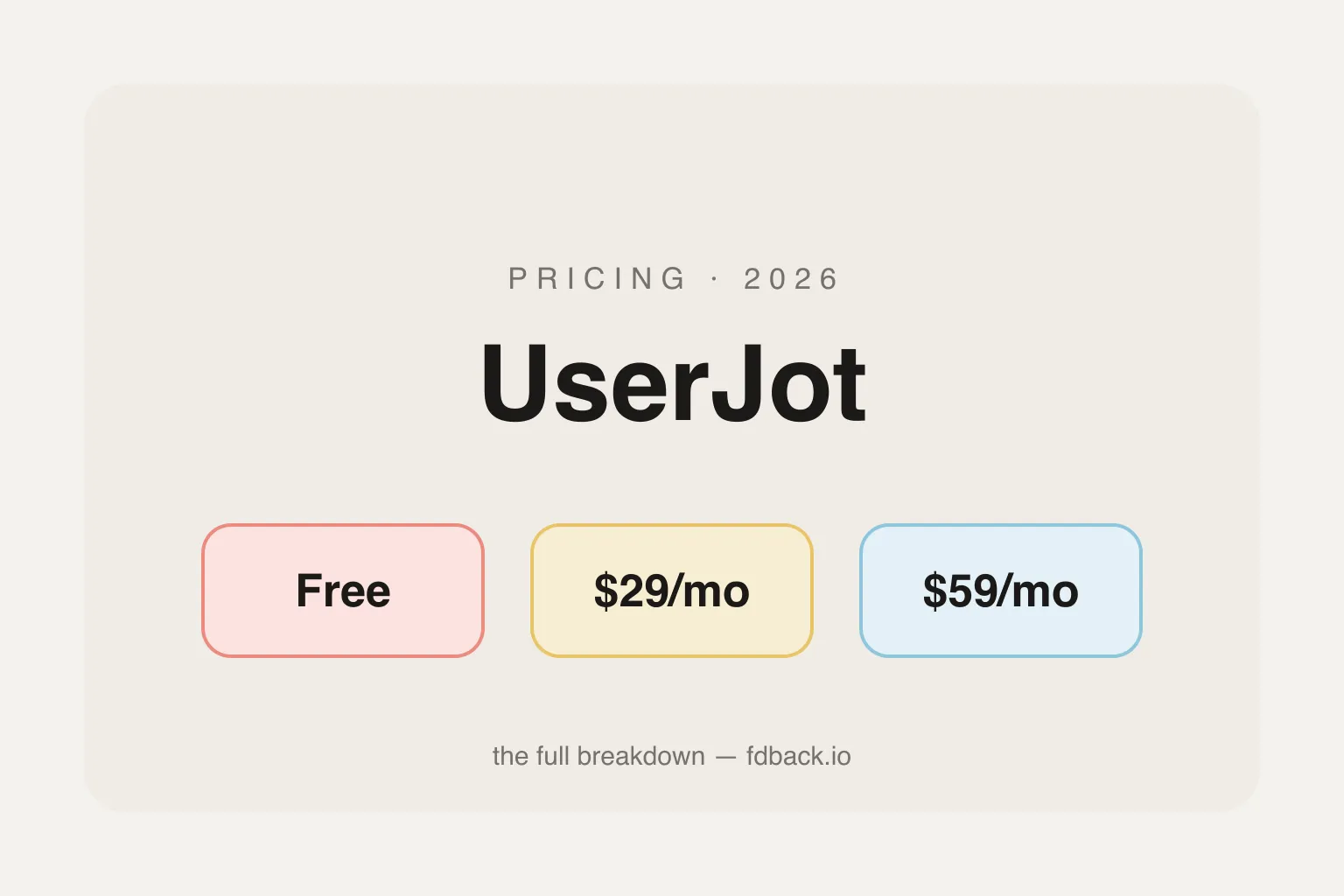
UserJot costs $0–$59/month flat with unlimited users on every plan. Full 2026 breakdown of what Free, Starter, and Professional actually include — and how it compares to fdback's $15/mo.
Feature Voting Boards: The Complete Guide for SaaS Teams
Complete guide to setting up feature voting boards for SaaS. Includes setup steps, best practices, and tools that close the feedback loop.
Featurebase vs Nolt 2026: All-In-One Suite or Minimal Board?
Featurebase bundles feedback, support, and AI at $29–99 per seat. Nolt keeps it to a $29/mo board with no changelog. Honest 2026 comparison with real costs.
Canny vs Productboard 2026: Feedback Loop or PM Platform?
Canny runs a public feedback loop; Productboard is an internal PM suite priced per maker. Compare pricing, features, and which job you're hiring for.