
UserVoice Pricing Explained: What You Actually Pay in 2026
11 min readUpdated August 20, 2026
On this page▾
Quick answer: UserVoice Discovery costs $999–$1,499/month with capped end users and no free plan: Growth is $999/month (200 users), Team $1,299/month (3,000 users, internal capture only), Strategic $1,499/month (5,000 users, everything combined), and Enterprise is custom (estimates from $2,000–3,000/month). The separate Validation survey product is $199/month. All Discovery plans require a minimum quarterly commitment — there is no month-to-month billing.
UserVoice is one of the oldest names in customer feedback software. It’s been around since 2008, it’s trusted by large enterprises, and it has a deep feature set for collecting, analyzing, and acting on product feedback.
It’s also one of the most expensive feedback tools on the market. The cheapest plan starts at $999 per month. There is no free tier. There is no self-serve signup. And even at that price, you’re capped at 200 end users.
If you’re a startup, indie founder, or small SaaS team evaluating feedback tools, those numbers probably just ruled UserVoice out. But if you’re at a larger company comparing enterprise options, or you’ve seen UserVoice mentioned alongside tools like Canny and Productboard and want to understand the pricing difference, this breakdown will help.
This guide covers every UserVoice plan, what’s included and what’s locked behind higher tiers, the hidden costs you won’t see on the pricing page, and how it compares to alternatives at every price point.
How UserVoice Pricing Works
UserVoice sells two separate products, each with its own pricing.
Discovery is the core product — feedback collection, idea management, voting, roadmaps, and analytics. This is what most people think of when they think of UserVoice. Plans range from $999/month to $1,499/month, with a custom Enterprise tier above that.
Validation is a separate microsurvey tool for testing product ideas before building them. It costs $199/month with unlimited surveys, responses, and seats. It’s a standalone product — you don’t get it bundled with Discovery.
All Discovery plans require a minimum quarterly commitment. There’s no monthly billing option. You either commit to 3 months upfront or pay annually for a discount. Annual billing brings prices down roughly 10-15%, but you’re still looking at a minimum annual spend of around $10,000-16,000.
There is no free plan. There is no self-serve trial you can spin up on your own. To get started, you need to book a demo with their sales team, go through an onboarding process, and commit to a contract.
Every UserVoice Plan Explained
Growth — $999/month
This is UserVoice’s entry-level Discovery plan. It includes a web feedback portal, an in-app feedback widget, a public changelog, status updates, and basic integrations.
The catch: it’s capped at 200 unique end users. That means only 200 people can submit feedback, vote, or interact with your portal. For most SaaS products, 200 engaged users is a small fraction of the user base. If you have 5,000 customers and even 5% engage with your feedback system, you’ve already exceeded this limit.
What Growth doesn’t include: project management integrations (Jira, Azure DevOps), user segmentation, revenue data connections, or internal feedback capture tools. These require higher plans.
At $999/month for 200 users, that works out to roughly $5 per tracked user per month — for a basic feedback portal with voting. Most alternatives offer the same functionality for $15-49/month total, with no user caps.
Team (Internal Capture) — $1,299/month
The Team plan shifts focus from public-facing feedback to internal feedback capture. Instead of collecting feedback through a portal, it helps customer-facing teams (sales, support, customer success) log feedback on behalf of users through integrations with tools like Salesforce, Zendesk, and Intercom.
The user cap increases to 3,000. You also get internal collaboration features, Slack and Microsoft Teams integrations, and the ability to connect feedback to customer account data.
However, this plan drops the public web portal and widget. If you want both internal capture and a public-facing portal, you need the Strategic plan.
Strategic (Premium) — $1,499/month
This is the plan most UserVoice customers end up on. It combines everything from Growth and Team: public portal, in-app widget, internal capture, user segmentation, revenue data, and all integrations.
The user cap is 5,000. For companies with larger user bases, this still might not be enough — and exceeding it means negotiating a custom Enterprise contract.
At $1,499/month ($17,988/year), you get what most modern feedback tools include in their $15-99/month plans: a feedback board, voting, a roadmap, status updates, integrations, and user segmentation. The difference is UserVoice wraps it in enterprise-grade analytics, compliance features, and a dedicated customer success manager.
Enterprise — Custom Pricing
For companies that need more than 5,000 users, advanced security (SSO, SOC 2), priority support, or custom integrations, the Enterprise plan requires contacting sales. Published estimates suggest pricing typically starts at $2,000-3,000/month, though it can go significantly higher depending on user volume and requirements.
Hidden Costs to Watch For
UserVoice’s pricing page looks straightforward, but several costs aren’t immediately obvious.
Add-ons. Features like advanced analytics, custom integrations, and white-labeling are available as add-ons. UserVoice doesn’t publicly list prices for these — you’ll need to negotiate them with the sales team. Depending on what you need, add-ons can increase your monthly bill by 20-50%.
Implementation and onboarding. UserVoice quotes a 4-6 week onboarding timeline. While basic onboarding is included, professional services for custom setup, data migration, or integration configuration may carry additional fees.
User cap overages. If you exceed your plan’s user limit, you’ll need to upgrade to the next tier. There’s no option to pay a small per-user fee — you jump from $999/month (200 users) to $1,299/month (3,000 users), a $300/month increase even if you only have 250 users.
No downgrade path. Once you’re on a quarterly or annual contract, downgrading mid-cycle isn’t straightforward. If your feedback needs change, you may be paying for a plan that no longer fits.
What UserVoice Does Well
UserVoice has been in this space for over 17 years. That longevity comes with genuine advantages.
Enterprise-grade analytics. UserVoice’s feedback analytics are more sophisticated than most competitors. You can segment feedback by account revenue, company size, plan type, and custom attributes. For large product teams making decisions that affect thousands of customers and millions in revenue, this level of insight is valuable.
Internal feedback capture. Most feedback tools focus on public-facing portals. UserVoice is one of the few that also captures feedback from internal teams — sales noting what prospects ask for, support logging common requests, customer success flagging churn risks. The Salesforce and Zendesk integrations pull feedback from where conversations already happen.
Validation product. The separate $199/month Validation tool lets you run microsurveys to test ideas before committing development resources. It’s a genuine differentiator — most feedback tools only help you collect ideas, not validate whether they’re worth building.
Compliance and security. For companies that need SOC 2 compliance, SSO, data residency controls, and enterprise security features, UserVoice delivers. These aren’t nice-to-haves for regulated industries — they’re requirements.
Dedicated customer success. Every UserVoice customer gets a dedicated CSM who helps with onboarding, feedback program design, and ongoing optimization. For teams new to structured feedback collection, this hands-on support can accelerate time to value.
Where UserVoice Pricing Becomes a Problem
The starting price excludes 95% of the market. At $999/month minimum with no free plan, UserVoice is inaccessible to indie founders, bootstrapped startups, small SaaS teams, and anyone who isn’t at a well-funded or enterprise company. The features on the Growth plan — a feedback portal, voting, and basic integrations — are available from competitors for $15-49/month.
200 users on the cheapest plan is unrealistic. If you embed a feedback widget in your app and encourage users to share ideas (which is the entire point), 200 users can be exhausted in weeks. You’re forced to upgrade to the $1,299/month plan just to accommodate normal engagement levels.
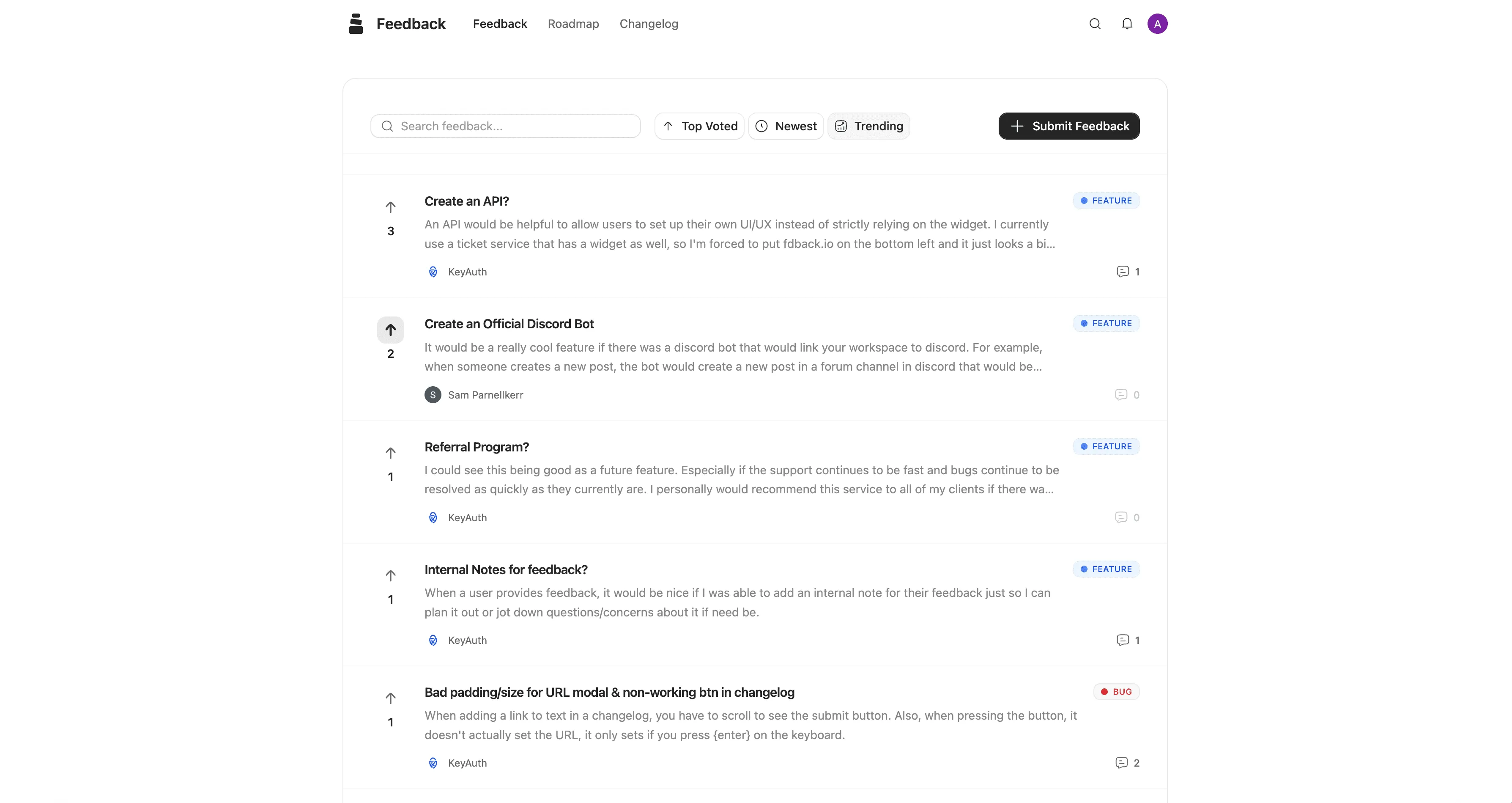
No public roadmap feature. Surprisingly, UserVoice doesn’t offer a public roadmap on any plan. You can update the status of ideas internally, but there’s no customer-facing page showing what’s planned, in progress, or shipped. Public roadmaps are standard in nearly every competing tool and are one of the most effective ways to build trust and reduce “when will you add X?” support tickets.
Outdated interface. Multiple user reviews across G2, Capterra, and other platforms mention that UserVoice’s UI feels dated compared to modern competitors. For a tool that costs $12,000-18,000/year, the user experience should feel premium. Instead, many users describe it as functional but clunky.
No self-serve option. You can’t sign up, explore the product, and decide if it fits your workflow. You have to book a demo, talk to sales, and commit to a contract. For product teams used to trying tools before buying, this is a significant friction point.
UserVoice vs. Alternatives: Price Comparison
Here’s what you’d actually pay for similar functionality across different tools.
| Feature | UserVoice Growth | Canny Pro | fdback | Featurebase |
|---|---|---|---|---|
| Monthly price | $999/mo | $79/mo+ | $15/mo | Free / $49/mo |
| User limit | 200 | ~100 (scales) | Unlimited | Unlimited |
| Feedback board | ✅ | ✅ | ✅ | ✅ |
| Voting | ✅ | ✅ | ✅ | ✅ |
| Public roadmap | ❌ | ✅ | ✅ | ✅ |
| Changelog | ✅ | ✅ | ✅ | ✅ |
| In-app widget | ✅ | ✅ | ✅ | ✅ |
| Voter notifications | ✅ | ✅ | ✅ | ✅ |
| PM integrations | Higher plans | Pro plan | ✅ | ✅ |
| User segmentation | $1,499/mo plan | Pro plan | ❌ | Paid plan |
| Free plan | ❌ | ✅ (25 users) | ❌ | ✅ |
| Annual cost | ~$12,000+ | ~$948+ | $180 | $588+ |
The difference is stark. UserVoice’s cheapest plan costs more per year than most teams spend on their entire SaaS tool stack. At $180/year, fdback delivers the core feedback-to-roadmap-to-changelog pipeline for 1/66th of UserVoice’s annual cost.
Canny’s pricing scales with tracked users, making it cheaper than UserVoice but still expensive at scale — a team with 1,000 tracked users on Canny Pro pays $579/month, about half of UserVoice but still 38x more than fdback.
For a full comparison of features and approach, see our UserVoice alternative guide.
When UserVoice Is the Right Choice
UserVoice makes sense in a specific scenario: you’re a mid-market to enterprise company with 50+ employees, a dedicated product team, thousands of customers, and a budget that treats $15,000-20,000/year for a feedback tool as a normal line item.
If you need Salesforce integration to connect feedback to account revenue, SOC 2 compliance for enterprise customers, sophisticated analytics that segment feedback by company size and ARR, and dedicated onboarding support — UserVoice delivers value that simpler tools don’t match.
Companies like this aren’t comparing UserVoice to $15/month tools. They’re comparing it to Productboard ($25+/maker/month, which adds up fast with large teams) or Aha! ($59+/user/month). In that context, UserVoice’s pricing is in the same range.
When to Look at Alternatives
For everyone else — indie founders, bootstrapped startups, small SaaS teams, and anyone building a product with fewer than 50 people — UserVoice is massive overkill.
If your needs are a feature voting board, a public roadmap, a changelog, and the ability to close the feedback loop when you ship what users asked for, you don’t need enterprise analytics or Salesforce integration. You need a tool that does the core workflow well and stays out of your way.
fdback does exactly this for $15/month flat. Feedback board, voting, public roadmap, changelog, in-app widget, voter notifications, custom domain — all included. No user caps, no per-seat pricing, no sales calls. For the cost of 5 days on UserVoice’s cheapest plan, you get an entire year of fdback.
If you need something between fdback and UserVoice — more features than a simple tool but less cost than an enterprise platform — Canny (from $79/month, scaling with tracked users), Featurebase (free tier, paid from $29/seat/month), or Productboard ($25/maker/month) are worth evaluating.
FAQ
How much does UserVoice cost per month?
UserVoice Discovery plans start at $999/month (Growth, 200 users), $1,299/month (Team, 3,000 users), and $1,499/month (Strategic, 5,000 users). Enterprise plans have custom pricing. The Validation microsurvey product is separate at $199/month. All Discovery plans require minimum quarterly billing — there’s no month-to-month option.
Does UserVoice have a free plan?
No. UserVoice does not offer a free plan or a self-serve free trial. To try the product, you need to book a demo with their sales team and go through a guided onboarding process. A 30-day trial is available after the demo, but it’s not self-serve.
What is a unique end user in UserVoice?
A unique end user is anyone who interacts with your UserVoice feedback system — submitting ideas, voting, or commenting. Each plan has a cap: 200 on Growth, 3,000 on Team, 5,000 on Strategic. Exceeding your cap requires upgrading to the next plan tier.
Is UserVoice worth it for a startup?
For most startups, no. At $999/month minimum with a 200-user cap, the cost is difficult to justify when alternatives offer the same core features (feedback board, voting, roadmap, changelog) for $15-49/month with no user limits. UserVoice is built for enterprise companies with enterprise budgets.
Does UserVoice offer a public roadmap?
No. UserVoice does not include a public-facing product roadmap on any plan. You can update idea statuses internally and notify users, but there’s no shared page where customers can see what’s planned, in progress, or shipped. Most competing tools include public roadmaps as a standard feature.
How does UserVoice compare to Canny?
Both are feedback management platforms, but they target different segments. UserVoice is enterprise-focused with plans from $999/month. Canny targets smaller teams with plans from $19/month but scales with tracked users (at 1,000 users, Canny Pro costs ~$579/month). Canny includes a public roadmap; UserVoice does not. For a detailed Canny pricing breakdown, see our Canny pricing guide.
What’s the cheapest UserVoice alternative with similar features?
fdback offers feedback boards, voting, a public roadmap, a changelog, and voter notifications for $15/month flat with no user limits. For the core collect-vote-plan-ship-notify workflow, it covers what most teams need at a fraction of UserVoice’s cost.
Can I migrate from UserVoice to another tool?
Yes. UserVoice supports data export via CSV and API. Most alternatives accept CSV imports for existing feedback data. The main consideration is timing — plan your migration before your next billing cycle to avoid paying for both tools simultaneously.
Enterprise Features, Indie Pricing
UserVoice charges $999/month for a feedback portal with 200 users. fdback gives you the same feedback board, voting, roadmap, and changelog — with unlimited users — for $15/month.
No sales calls. No quarterly commitments. No user caps.
More insights to explore
UserJot Pricing Explained: What You Actually Pay in 2026
UserJot costs $0–$59/month flat with unlimited users on every plan. Full 2026 breakdown of what Free, Starter, and Professional actually include — and how it compares to fdback's $15/mo.
Featurebase vs Frill 2026: Which Modern Feedback Board Wins?
Featurebase charges per seat plus AI fees; Frill is flat-rate with add-ons and idea caps. Full pricing math, feature tables, and the winner by team size.
Canny vs Productboard 2026: Feedback Loop or PM Platform?
Canny runs a public feedback loop; Productboard is an internal PM suite priced per maker. Compare pricing, features, and which job you're hiring for.
Feature Voting Boards: The Complete Guide for SaaS Teams
Complete guide to setting up feature voting boards for SaaS. Includes setup steps, best practices, and tools that close the feedback loop.
How to Handle Duplicate Feature Requests: Detection, Merging, and Process
Duplicate feature requests are demand signal, not noise. Learn how to detect them, merge them without losing votes, and build a process that scales.
Best Feedback Tools for SaaS Teams in 2026
An honest comparison of the best SaaS feedback tools in 2026 - from $15/mo to $999/mo. Feature voting, roadmaps, changelogs, and pricing compared side by side.